

How Software Testing Services Help Businesses Prevent Costly Software Failures
Imagine launching a new business application after months of development, only to discover that customers cannot complete payments, important pages load slowly, or the login system fails on certain devices.
Even a small software defect can interrupt business operations and damage customer confidence. For companies that depend on websites, mobile applications, eCommerce platforms, or internal business software, reliability is essential.
The challenge is that software may work correctly during basic development checks but still fail when real users interact with it under different conditions.
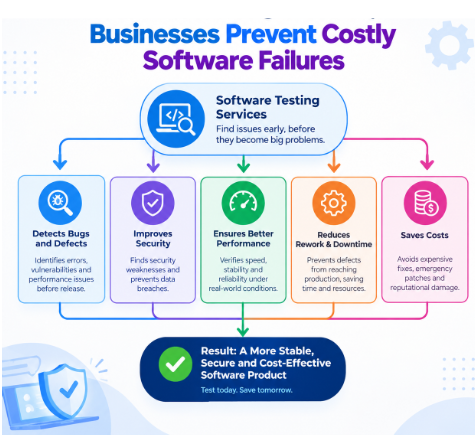
This is why software testing services are an important part of the software development lifecycle. They help businesses identify defects, evaluate functionality, assess performance, and check whether an application meets its intended requirements before and after deployment.
Rather than treating testing as the final step before launch, businesses should integrate quality assurance into development from the beginning.
Why Do Software Problems Occur After Launch?
Software failures rarely have a single cause. They can result from incomplete requirements, overlooked user scenarios, incompatible devices, integration issues, or changes that unintentionally affect existing features. Here are some common situations businesses should consider.
1. Important Features Work Only in Certain Situations
A registration form may work correctly with standard information but fail when a user enters an unexpected character. Similarly, a booking system may function normally for one customer but encounter problems when several users make requests simultaneously. Testing different scenarios helps teams identify these issues before they affect customers.
2. Website or Application Updates Break Existing Features
Developers regularly introduce new functionality, fix defects, and update integrations. However, a change in one part of an application can affect another part. For example, changing the checkout process might unintentionally break discount calculations or order confirmation emails. Regression testing helps verify that previously working features continue to function after updates.
3. Applications Perform Poorly Under Heavy Traffic
An application that works well with a small number of users may slow down when traffic increases. Performance testing helps identify bottlenecks involving databases, APIs, servers, and application processes. Businesses can then address these problems before they affect a larger number of users.
4. Security Weaknesses Remain Undetected
Applications may process customer information, account credentials, payment-related data, or confidential business records. Weak authentication, incorrect access permissions, and insecure data handling can expose sensitive information. Security testing helps identify vulnerabilities and supports the implementation of appropriate safeguards.
Testing does not guarantee that an application is completely secure, but it is an important component of a broader security strategy.
How Professional Software Testing Services Solve These Problems
Professional testing combines structured test planning, practical execution, defect reporting, and verification. The exact approach depends on the application's complexity and business risks.
Functional Testing
Functional testing checks whether software features behave according to the requirements. For an eCommerce website, this may include checking product searches, shopping carts, discount codes, checkout workflows, payment responses, and order confirmations. For a business application, it may involve checking user registration, data entry, report generation, permissions, and approval workflows. The goal is to identify incorrect behaviour before it disrupts business operations.
Automated Software Testing
Automated testing uses scripts and specialised tools to execute predefined checks with less manual intervention. It is particularly useful for repetitive scenarios, such as verifying login functionality, checking form validation, or confirming that key features continue to work after frequent updates.
Automation can improve testing efficiency, but it does not eliminate the need for human judgement. Complex user experiences and unexpected behaviour may still require manual evaluation.
Manual Software Testing
Manual testing allows testers to explore an application as a real user would. Testers can assess navigation, usability, content clarity, workflow interruptions, and unusual situations that automated scripts may not fully cover. This approach is valuable when evaluating new features, complicated workflows, and interactions that require human observation.
Performance and Load Testing
Performance testing evaluates how an application behaves under expected and demanding conditions. It can help businesses investigate slow page loading, delayed API responses, database bottlenecks, and instability during periods of high demand. Testing results can guide improvements before a marketing campaign, seasonal sales event, or product launch increases traffic.
Cross-Browser and Device Testing
Users may access a website through different browsers, operating systems, screen sizes, and mobile devices. Cross-browser and device testing helps identify layout problems, compatibility issues, and features that behave differently across environments. This is especially important for businesses that rely on online enquiries, customer portals, or mobile-friendly eCommerce experiences.
When Should a Business Invest in Software Quality Assurance?
Businesses do not need to wait until an application experiences a major failure before investing in quality assurance. Testing is particularly important in the following situations:
- Before launching a new product: Verify essential features, workflows, and user journeys before making the software available to customers.
- Before releasing major updates: Check whether new functionality affects existing features.
- After integrating third-party services: Verify connections involving payment gateways, CRM platforms, shipping systems, APIs, and other external tools.
- When customers report recurring problems: Reproduce the reported issues, identify their causes, and verify fixes.
- Before scaling operations: Evaluate performance and capacity as user numbers and transaction volumes grow.
- When handling sensitive information: Assess security controls and access permissions alongside other appropriate security measures.
The best testing strategy prioritises the workflows that could create the greatest financial, operational, or reputational impact if they fail.
How to Choose the Best Software Testing Company
Selecting a testing partner involves more than comparing prices. Businesses should look for a team that understands the application, identifies risks, communicates clearly, and provides actionable findings. Consider these factors before choosing a provider.
- Industry and technical experience: Look for relevant experience with your type of software, technology stack, integrations, and user workflows.
- Testing coverage: Confirm whether the team can provide functional testing, regression testing, automation, performance testing, usability checks, and security testing according to your requirements.
- Clear defect reporting: Reports should explain how to reproduce an issue, what was expected, what actually happened, and how serious the problem may be.
- Integration with development: Testing should fit into the development process rather than operate as an isolated activity immediately before release.
- Scalable testing approach: Your testing requirements may change as your product grows. Choose an approach that can adapt to new features, users, and technical complexity.
- Ongoing support: Discuss how retesting, regression checks, release validation, and future updates will be handled.
A reliable testing partner should explain the risks it identifies instead of simply providing a pass-or-fail report.
How Mithila Softech Can Support Software Quality
Mithila Softech offers software testing and quality assurance services for businesses seeking to identify defects, improve application reliability, and support more dependable releases. Its software testing service combines automated and manual testing, regression checks, exploratory testing, and security assessments.
For businesses evaluating software testing services, the right starting point is to identify their current challenges. These might include recurring bugs, unreliable integrations, slow application performance, or difficulties maintaining quality during frequent releases (see also why business software creates more work). A structured assessment can help determine which testing activities are most appropriate for the application and where improvements should be prioritised.
Ready to launch with confidence? Explore Mithila Softech's Software Testing and QA Services, or contact our team to discuss your project and get a practical testing plan before your next release.
Conclusion
Software quality affects more than technical performance. It influences customer trust, business continuity, operational efficiency, and the experience people have when using a digital product.
By identifying defects early, testing critical workflows, checking compatibility, evaluating performance, and validating fixes, businesses can reduce avoidable risks associated with software releases. Professional software testing services provide a structured way to evaluate application quality and make informed decisions before problems affect customers.
For businesses planning a new launch or improving an existing application, investing in quality assurance can be a practical step toward more reliable software and sustainable growth.
Frequently Asked Questions
1. What are software testing services?
Software testing services involve evaluating software to identify defects, verify functionality, assess performance, and check whether an application meets its requirements. Depending on the project, these services may include manual testing, automated testing, regression testing, compatibility testing, and security assessments.
2. Why are software testing services important for businesses?
Software testing helps businesses identify problems before they disrupt customers or operations. It can improve application reliability, reduce repeated defects, support better user experiences, and help development teams make more informed release decisions.
3. What is the difference between manual and automated software testing?
Manual testing involves people evaluating software through direct interaction, while automated testing uses scripts and tools to execute predefined checks. Manual testing is useful for exploratory scenarios and usability evaluation, whereas automation is particularly effective for repetitive tests and regression checks.
4. When should software testing begin during development?
Testing should begin during the requirements and design stages and continue throughout development. Early testing helps teams identify unclear requirements and defects before they become more expensive or complicated to correct.
5. How can I choose the best software testing company in India?
Evaluate a company's technical expertise, testing methods, industry experience, reporting quality, communication, and ability to support ongoing releases. Ask for a clear testing plan that addresses your application's risks, business requirements, and expected outcomes.
← Back to Blogs