
For a business owner, developing an app should not be about simply having an app on the Google Play Store or Apple App Store. The real value comes from solving a specific business problem.
Many companies still manage orders through phone calls, track customers in spreadsheets, communicate through multiple messaging platforms, or depend on employees to manually update information. As the business grows, these processes can become slow and difficult to control.
A properly designed mobile application can bring these activities into one structured system.
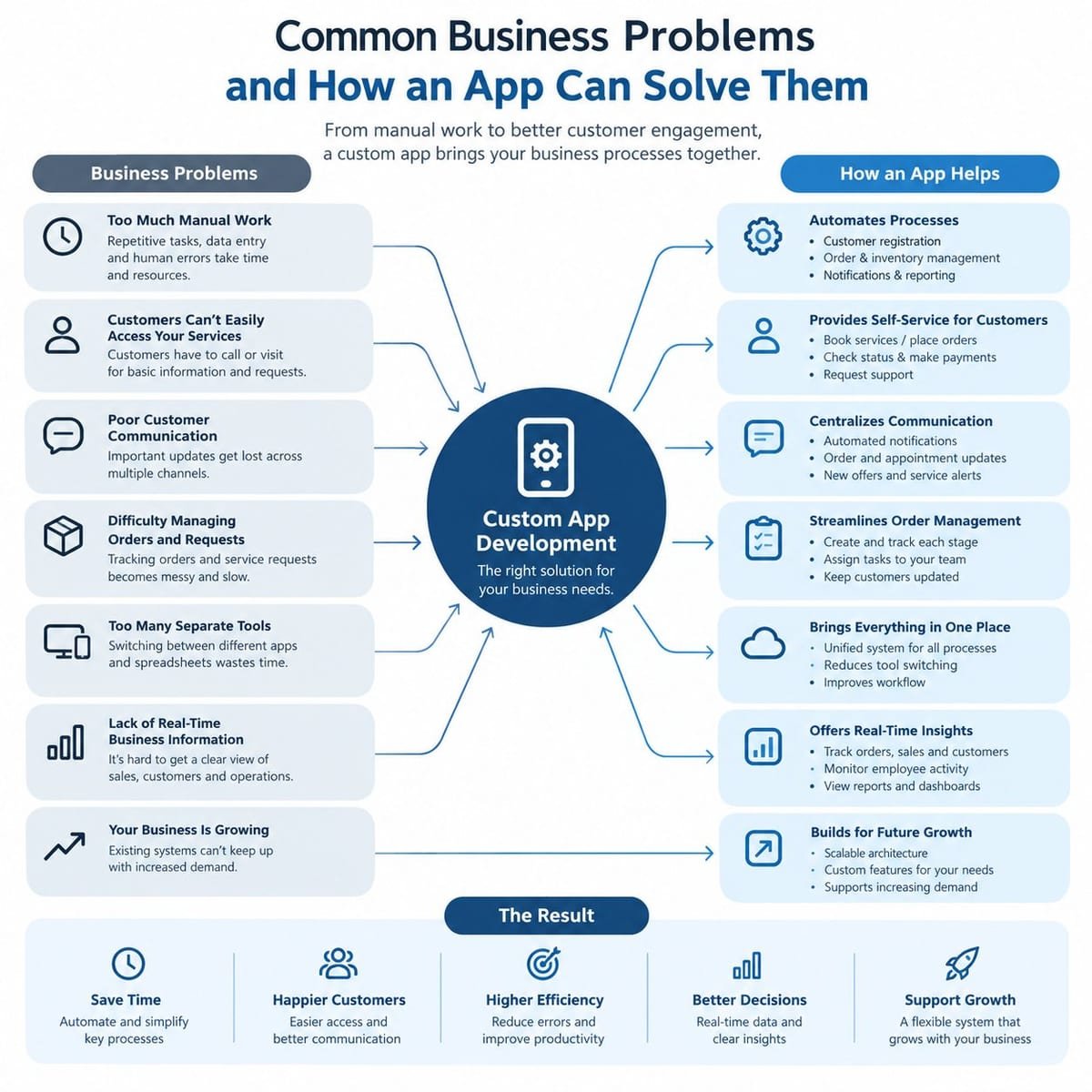
1. Too Much Manual Work
One of the biggest problems businesses face is repetitive manual work. Employees may have to enter customer information, update orders, check availability, send notifications, create reports, or move information between different systems.
This takes time and can also increase the possibility of human errors.
How an app can help:
A custom application can automate processes such as:
- Customer registration
- Order management
- Appointment booking
- Inventory updates
- Payment tracking
- Notifications
- Employee task management
- Report generation
Instead of employees repeatedly performing the same tasks, the application can handle predefined workflows automatically.
2. Customers Cannot Easily Access Your Services
If customers have to call your business for every small requirement, it can create unnecessary friction. For example, a service company may receive calls for appointment booking, order status, pricing information, or service requests.
A mobile app can provide customers with a self-service platform. Customers can potentially:
- Book services
- Place orders
- Check order status
- Make payments
- Request support
- View account information
- Receive updates
This gives customers a more convenient way to interact with the business.
3. Poor Customer Communication
Businesses often communicate with customers through different channels. Important information can become difficult to track when conversations are spread across phone calls, emails, messaging apps, and social media.
A business application can centralize important customer communication. For example, the app can send automated notifications for:
- Order confirmations
- Appointment reminders
- Payment updates
- Delivery status
- New offers
- Service updates
This can make communication more organized while reducing the amount of repetitive communication handled manually by employees.
4. Difficulty Managing Orders and Requests
Businesses handling a large number of orders or service requests can struggle when everything is managed manually. An application can create a structured workflow. For example:
Each stage can be recorded within the system. Business owners can then have better visibility into what is happening instead of depending entirely on individual employees for updates.
5. Employees Are Using Too Many Separate Tools
Another common problem is tool fragmentation. A company may use one tool for customer information, another for internal communication, spreadsheets for tracking, and different software for payments or reporting. Employees then spend time switching between platforms.
Custom app development can help create a centralized system based on the company's actual workflow.
The objective is not necessarily to replace every existing tool. Instead, the application can be designed to connect important business processes and reduce unnecessary duplication through CRM integration and custom web applications.
6. Lack of Real-Time Business Information
Business owners need accurate information to make decisions. If sales, customer requests, inventory, employee activity, or service data are stored in different places, getting a clear picture can take considerable time.
A business app can provide dashboards and reports based on the information collected through the application. For example, management may be able to monitor:
- New orders
- Completed orders
- Pending requests
- Customer activity
- Revenue-related information
- Employee tasks
- Inventory levels
The exact dashboard should depend on what information the business actually needs to make decisions.
7. The Business Is Growing but Existing Systems Are Not
A process that works for 20 customers may become difficult when a company has 2,000 customers. This is where businesses should evaluate whether their current systems can support growth.
Custom app development allows the technology to be planned around the business workflow. Instead of forcing the company to change its entire process to fit generic software, developers can build features around specific operational requirements.
How to Start an App Development Project
Before contacting an app development company, business owners should identify the actual problem first. Ask these questions:
- What process is currently taking too much time?
- Where are employees making repeated errors?
- What do customers frequently ask for?
- Which business information is difficult to track?
- Which tasks should be automated?
- What should customers be able to do without contacting employees?
The answers can become the foundation of the application.
Start With an MVP
Businesses do not always need to build every possible feature from day one. A better approach can be to create a Minimum Viable Product (MVP) containing the features that solve the most important problem. For example, a service business might initially need:
- Customer registration
- Service booking
- Payment integration
- Booking management
- Notifications
- Admin dashboard
Additional features can be introduced after the business understands how customers and employees use the application. This approach can help control development costs and allow the company to validate the idea before investing in a larger system.
Choose Technology Based on the Business Requirement
There is no single technology that is suitable for every application. Depending on the project, businesses may need Android development, iOS development, cross-platform development, backend development, APIs, cloud infrastructure, payment integration, analytics, or third-party integrations.
The technology decision should follow the business requirement rather than the other way around. For example, a company that needs an employee application, customer application, and web-based admin panel may require a different architecture from a simple booking application. Pairing this with high-caliber UI/UX design and comprehensive QA testing ensures a reliable, user-friendly outcome.
Conclusion
App development can become a practical business solution when it starts with a clearly defined problem.
Whether the challenge is excessive manual work, poor customer communication, fragmented processes, difficult order management, or limited access to business data, a properly planned application can bring important processes into one system.
For business owners, the key question should not be “Do we need an app?” It should be: “Which business problem should the app solve?”
Once that problem is clearly identified, the right features, technology, integrations, and development approach can be planned around it.
Mithila Softech collaborates with startups, enterprises, and established businesses to build custom mobile and web applications that solve core business problems and foster scalable growth. Explore our mobile app development insights or contact our app developers today to turn your requirements into a robust mobile solution.
Frequently Asked Questions
1. How can app development help a small business?
A business app can help small businesses simplify processes such as bookings, orders, customer communication, payments, and internal task management. The features should be selected according to the company's specific operational needs.
2. Does every business need a mobile app?
No. An app is useful when it solves a genuine business or customer problem. Businesses should first identify the process that needs improvement and then determine whether an application is the right solution.
3. What is custom app development?
Custom app development involves creating software specifically around a company's requirements, workflows, users, and business processes rather than relying entirely on a generic application.
4. Should a business build an MVP first?
For many projects, an MVP can be a practical starting point. It allows a business to launch the most important functionality first, collect user feedback, and determine which additional features should be developed later.
5. How do I decide what features my business app needs?
Start by identifying the biggest operational and customer problems. List repetitive tasks, customer requests, communication issues, data-management problems, and processes that are difficult to track. These requirements can then be converted into app features and workflows.